OUR HISTORY

Fisher History
An account by Alan Taphouse during his time as Sales Director at Northshore Yachts.
The Fisher Range - Classical Quality
Man has striven for centuries to master the elements, to fly like a bird or swim like a dolphin, but
his dream has always been just out of reach. Yet when it comes to harnessing the power of wind
and wave mans skill and ingenuity has brought him much closer to achieving his nirvana and
realising the dream. Since first casting himself upon the waters with a tree trunk or perhaps a
bundle of sticks man hasnt looked back. The perfect combination of hull, mast and sails has
evolved over hundreds of years into the seaworthy craft that we enjoy today.
Every yachtsman probably has some idea of what his ideal yacht would look like, but few ever
have the chance to commission a Naval Architect to bring that dream to realisation. The story of
how the most classical of motor sailers came to be, begins more than four decades ago in the last
months of 1969.
During the late Sixties, GRP had become firmly established as a suitable hull material for even the
very finest yachts that the industry could build. However, despite this the range of different yachts
available to meet an ever increasing demand, was still limited with very little for the prospective
owner to choose from.
The search for the right craft for many yachtsmen was a frustrating if not fruitless exercise which
often ended in an unhappy compromise. Not least amongst the frustrated were naval architects
David Freeman and Gordon Wyatt who were seeking a motor sailer similar to those so popular in
Scotland and Scandinavia.
The pair had a very clear idea of what was wanted, listing their likes and dislikes before embarking
on a search for their ideal craft. She would be neither a yacht with a small auxiliary power unit, nor
a motor cruiser with a token sail set upon a stumpy mast, but instead a real motor sailer with good
performance under power or sail.
However after months of looking produced nothing vaguely resembling their dream, the only
solution left to them was to design and build their own boat. The decision on what to build was
easy as the specification was already written down, but in the final analysis the writing turned out to
be the easiest part of their task.
The concept called for a traditional hull with the sea keeping characteristics of the sturdy North Sea
Fishing boats while retaining the easy sailing motion of the yachts launched by Millers and other
Scottish yards.
On their drawing board the basic shape of this double-ended working hull gained a pronounced
sheer and finer ends, to keep her decks dry and improve sailing performance. The addition of a
long keel brought balance for the sloop rig and ensured good directional stability in a sea-way.
Finally when the weather was less than kind deep bulwarks kept the crew safe when they were
working around the decks.
The design was named the Freeward 30 and during 1970 as work progressed on the plug, mould
and finally the first hull, David and Gordon started marketing their ideas to the established buildersand yards. They had little success even at the Earls Court Boat Show which they attended in the
January of that year hoping perhaps to even sell their design.
After many hours tramping around the Show they took a break and as these things will happen, sat
down close to a man who was equally weary of trying to persuade builders to let him distribute their
yachts. Maybe it was because the frustration was so clearly written all over their faces, that they
were soon discussing their common experiences, quickly realising that they might have the
answers to each other problems the third man was David Skellon.
This meeting blossomed into closer collaboration which saw the
production and sale of a number of the early Freeward 30s. During
late 1970, flushed with their modest initial success, but still listening
to the comments of their actual and prospective owners, they sought
to change the design slightly.
As the original intention had been to follow the pattern of the fishing
craft from both sides of the North Sea, the first step was to change
the yachts name to Fisher. Continuing the fishing boat theme a large
wheel-house with forward sloping windows was added and so what
is now the distinctive profile of the Fisher was almost complete.
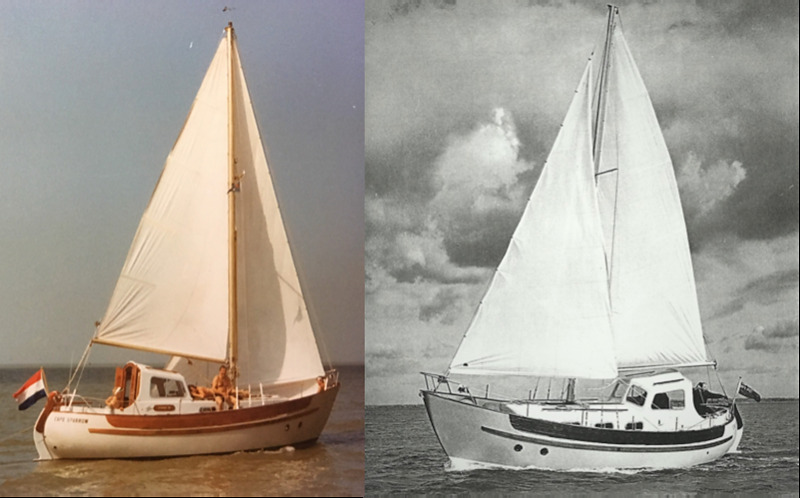
Cape Sparrow - the first Freeward 30
The wheel-house was fitted for strictly practical reasons rather than in any attempt to create an
image. Many Scandinavian and Baltic yachts extend their sailing season by protecting the steering
position while also providing what could best be described as an on-deck saloon with all round
visibility.
If such a thing were possible, the change of name and two major alterations to the design shape
popularised the yacht even more. The family of Fishers was born.
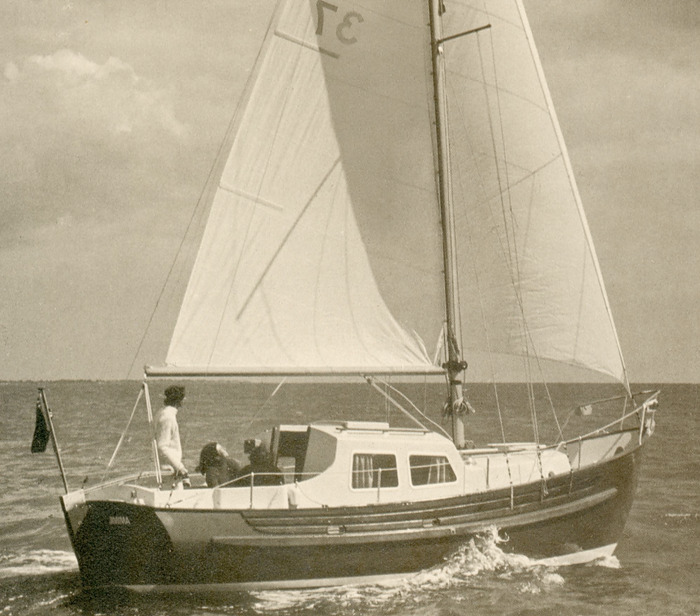
The Freeward 25
A number of these vessels were produced as an alternative to the
Standard Fisher 25 and are often sought after, being something of a
classic. Two particularly good examples are - Lynnie II owned by
Melvin Cliffe and - Jemima once owned by John Warne. Jemima
was restored and refitted by John, who is now Managing Director of
Northshore.
Photo Northshore Yachts
The benefits of the double-ended hull form have been recognised by the boat builder and seaman
alike for thousands of years. The Romans, Greeks and Vikings all valued the seaworthiness of a
hull, which could safely take its crew across the North Sea or Atlantic Ocean.The Norwegian designer and builder, Colin Archer, is considered by many to have introduced the
double-ended concept into yacht design. In fact the craftsmen at his Bergen yard were only
following the traditions of their forebears who had been building double-enders ever since the first
Longboat was launched.
The style of hull is almost compulsory, because of its outstanding sea keeping integrity, for many of
the fishing boats, which have evolved around the coasts of Northern Europe. Yet if Archers ideas
and values can be said to have continued and evolved since his death then the Fisher range must
be the epitome of the modern Colin Archer motor sailer.
The Fisher 30 made her maiden appearance at the 1971 Southampton Boat Show, laying the
foundations for the companys subsequent success. The last major alteration to the original design
was made at this time when the sloop rig of the Freeward was changed to ketch, as it was more in
keeping with the style of the Fisher. The final member of the team, who was to have a major
influence upon the ultimate development of Fisher, became involved at this time - he was Bryan
Moffatt.
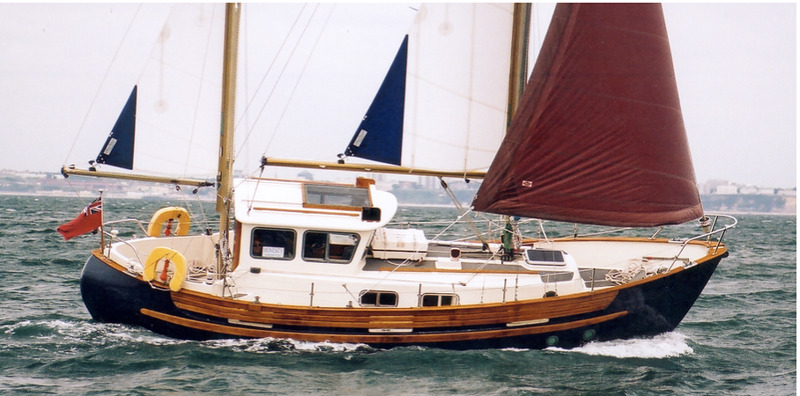
Honesty - a Fisher 30 built in 1979 sailing in Poole
Bay bound for Lymington and the
North Channel Buoy. She is a good example of the
Mark II version proving that updated and well
maintained vessels can cheat the ravages of time.
Photo Alan Taphouse
Bryan who had been a boatbuilder since 1958, had just started Northshore Yacht Yards Ltd after
leaving Dell Quay which he had helped to found. Fairways, the original company, was principally a
marketing organisation and although they had built Fishers they very soon asked Northshore to
mould and build some of the range. This continued for a number of years before the whole
company was finally taken over by Northshore in 1981.
The move by Northshore to Itchenor in 1973, to be later joined by Fisher, was in many ways very
fortunate. Chichester, being a natural harbour, has been a cradle of boat building since the
Caesars conquest when the Romans built a Port there. Charles II kept Tubbs, one of his yachts,
close to Itchenor, although whether this was due to the reputation of the craftsmen or the proximity
of the Kings mistress at nearby Itchenor House isn't clear.
The skilled workmanship, which was so readily available then, is one of the things on which Fisher
and Northshore pride themselves today. The modern, classical yacht requires just the same high
quality craftsmanship that completed her earlier sisters.
One of the most popular features of any Fisher is that the design has been carefully thought out
and planned for living aboard, whether in the cold waters of the North or the heat of the Tropics.
The large wheelhouse, which affords so much protection, opens into the cockpit which has a
second tiller steering position for fair weather sailing.While David Skellon concentrated on marketing the new yacht, Freeman and Wyatt were able to
devote more time to thinking about what should come next; should the next Fisher be larger or
smaller? The comments and suggestions of owners, plus the valuable input of Skellon, clearly
indicated that, if anything, owners were seeking to go further afield, but just how much?
another seven feet was the answer.
The Fisher 37, which first appeared in 1973, is the largest of the range in regular production, which
says a great deal for detailed original design work. Fisher were already earning themselves an
unrivalled name for quality craftsmanship, and the appearance of the 37 could do no more than
confirm this.
In common with her smaller sister, the 37 retained the deep bulwarks and the high ballast ratio of
50%, which ensures that Ocean passages are effortless, safe and comfortable. The large hull
allows increased fuel and water tanks, so extending the cruising range to 700 miles under power
and making long passages a practical proposition.
It didn't take owners long to take this new Fisher, not only to their hearts, but also to the far corners
of the globe. To cross the Atlantic was common-place with Fishers spanning the Pacific from
Vancouver to Japan. Well equipped, a Fisher would sleep her owner and his guests in comfort and
privacy, whether at sea, along a marina pontoon or in some secluded anchorage.
Aboard the 37 and all her sisters, the combination of teak and soft furnishings throughout the
cabins and saloon were no accident. Professional designers took great pains to ensure that the
colours blended to create a pleasant and restful atmosphere. Its essential aboard any cruising
yacht for the crew to have ample space to stow their belonging and personal effects. So, no matter
which Fisher you own, there is always a place for everything.
Not everyone wants, or is perhaps able, to sail the oceans of the world, and this was the principal
influence determining the next Fisher to be launched - the 25. Sometimes regarded as the ugly
duckling of the fleet, first hand experience of the Fisher 25 soon proved this sturdy little craft to be
much closer to a small swan. (with apologies to Hans Christian Anderson)
In 1975, the 25 joined the rapidly growing fleet of Fishers
sailing the seas of the world, typically displaying all the
attention to detail that Wyatt and Freeman had bestowed on
the earlier yachts. Some compromises had to be made, most
notably the flat stern and transom hung rudder, although the
wheelhouse and ketch rig were retained. Despite her size
she could still sleep five, although this was an option for the
odd weekend rather than a prolonged cruise. In addition a
Freeward 25 was also produced around this time together
with a Fisher Potter version intended for sport fishing.
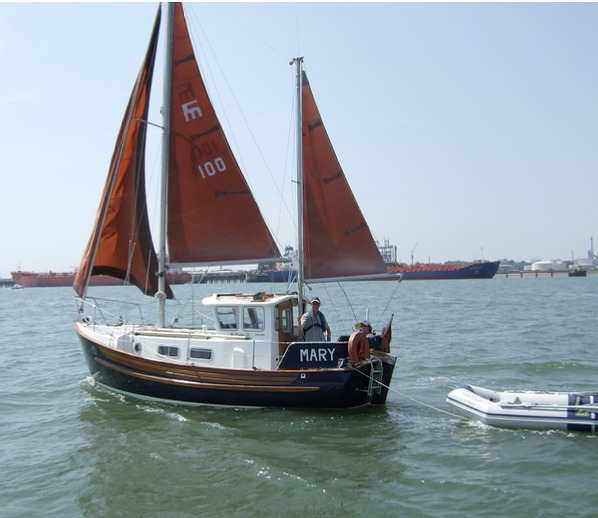
Fisher 25 Mary, leaving Southampton Water
Soon these smaller Fishers were to be seen all over Europe and beyond, taking their owners into
the Baltic or through the French Canals to the Med. Despite her size, she proved to be a splendid
sea boat reaching the safety of port with the minimum of fuss and effort. In fact the 25 has proved
to be the first stepping-stone for many owners who, once they had fallen under the spell of the
Fisher, moved up to a larger craft as soon as they could.After the 25, Wyatt and Freeman turned their attention to filling out the mid range, launching the 34
in 1977. A remarkable achievement, as they had designed a new yacht every two years since
1971, all of which are still in production. The 34 has turned out to be one of the most popular
designs of them all, displaying all the usual Fisher features. The ketch rig is nicely balanced with all
the sheets and controls led aft to the cockpit and outside steering position. All come easily to hand
so that sailing in the restricted waters of river or estuary allows the maximum enjoyment with the
minimum of effort.
A Fisher never fails to amaze those used to sailing aboard sleeker, more racy types of yacht as to
just how well she performs sailing up wind. Often, because of her long keel and easy motion in a
seaway, she will outperform the lighter hulls to arrive in port with a crew who are dry, warm and
most important of all, relaxed.
1978 brought the launch of the largest and unquestionably the most luxurious Fisher, the 46 whose
owners enjoy every facility, including their own en suite heads and shower. A very spacious saloon
serves the occupants of three separate cabins and the owners state-room aft. The Fisher 46 is,
without doubt, the best of all worlds.
The latest chapter in the Fisher story begins in 1981 when it was decided to replace the original 30.
The length was increased by a foot and the Fisher 31 was born. The extra length and beam
allowed improvements above and below decks, a larger wheelhouse, a separate quarter cabin
below, plus other detailed refinements.
Any visitor to the Northshore yard will very soon realise that personal service and attention to detail
are a very important part of Fisher ownership. This starts from the moment of the first enquiry and
continues through however many visits the owner needs to discuss the various personal detailed
alterations required to build a yacht unique to its owner.
The practice of building a yachts accommodation from a series of GRP mouldings was never a
seriously considered opinion at Northshore. They devote much time and effort fitting out in wood,
thereby creating a boat which is not only comfortable to sail, but also to live aboard. The
craftsmanship that is lavished upon the interior, for example, illustrates the care and attention to
detail which is the hallmark of all Fishers and a testimony to the effort made by everyone at
Northshore where only perfection will do. It takes 12 weeks to build a Fisher and from the day she
enters the fitting out shop until the launch of the completed yacht, the same team of craftsmen
work on her. This is perhaps why minor differences in detail make each yacht personal to her
owner and why Northshore so rightly pride themselves on the effort they make to deliver the reality
that fulfils the owners dream.
The Naval Architect must always strike a balance between the number of berths he can provide
and the comfort which must be sacrificed in order to accommodate them. Careful research
identified that the Fisher owners mainly sail with their family or a couple of friends, particularly after
the children had grown up. Consequently, with the exception of the 46, the whole Fisher range has,
from the beginning, been designed to take a crew of four or five wherever they may wish to go
without comfort or safety being sacrificed for convenience.
One of the more remarkable facets of the Fisher family has been their performance at sea whether
under sail or power. Each yacht has an engine installed which will provide a minimum of 5hp for
each tonne of her displacement: ample power to push any craft against a foul tide and a rising sea,
with the crew untroubled by the easy motion of the long-keeled hull. The engine, as befits a motor
sailer of this high quality, is more than capable of providing the power for items of additional
equipment the fridges and freezers which are so essential to long passages and hotter climates.Also the navigation and radio equipment to cope with poor visibility and safely traverse the worlds
oceans.
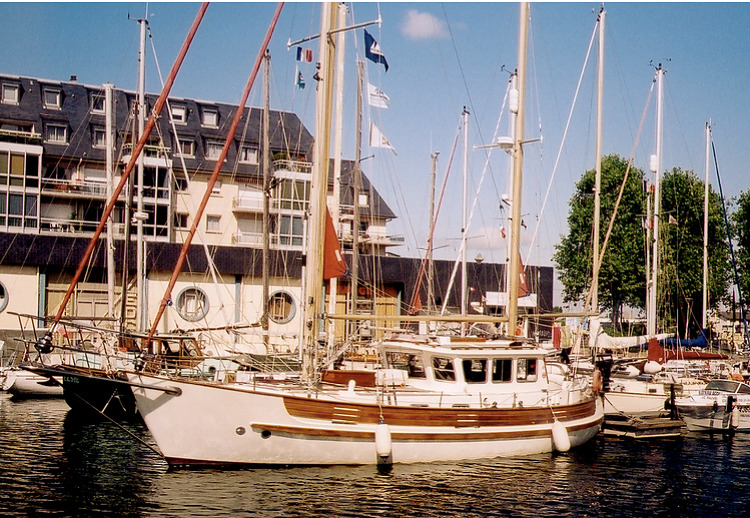
Lucky Sarah a Fisher 46, the largest of the Fisher Range of
Motor Sailers
Here berthed in the central basin at Caen having entered the
Caen Canal at Quistreham together with a number of other
Fishers In 2001.
Northshore are constantly seeking ways to ensure that all Fishers are equipped to meet the
requirements of their owners and advances in technology. The Fisher will be as much a yacht for
the the 21st century as she has been of the 20th and while the story of this Classical Motor Sailer
is up to date it is by no means finished.
Whichever member of the Fisher Family you choose, there are already over 1000 yachts sailing
world wide, each carrying countless new friends who communicate regularly with the flourishing
Owners Association. We are confident that aboard your Fisher you will enjoy many years of safe
sailing, during which the only events will be pleasurable ones.
…………………………………………………………………………………………………………………
Note:
There is a wealth of information on the Fisher Motor Sailer class, available on this website (but you have to be a member to see it)
If you already own a Fisher, you can join us as a Full Member. If you are looking for a Fisher or are just interested in these lovely vessels,
you can join as an Associate Member.
Last updated 10:55 on 27 January 2026